please note all photos can be viewed larger by opening in a new tab (right-click)
The city of Swakopmund is situated at the edge of the Namib Desert, at the southern tip of the Skeleton Coast. It was founded in 1892 as the main harbor for German South West Africa and today it's a popular beach resort town and holiday destination. It's renowned for the beautiful colonial German architecture, but the city had its dark sides, too. During the Herero and Nama Wars, just past the turn of the 20th century, when German soldiers wiped out 80% of the indigenous Herero population and 50% of the Nama population, a concentration camp for Herero people was located here. The "Wars" were eventually and rightfully re-termed as genocide. Swakopmund was also known for its continued glorification of Nazism after World War II. Today, though, it's primarily focused on tourism, and I have found it to be a delightful town in which to be a tourist.
One thing to note if you plan to come here, is the very different climate from most of the rest of Namibia. It has very moderate temperatures compared to inland, and can be downright cold at times. In October 2023, I came in from 100+ degree days in the Kavango and Etosha to 60s in Swakopmund, and colder at night. The hotel I stayed in didn't have heaters -- I sat in my room trying to work at nights with two pairs of socks and slippers, lounge pants on top of my pajama pants, a long sleeve shirt on top of a short sleeve one and then the sweater I brought for the airplane. And finally my friend, Poppie, loaned me a coat to top it off with. Then we left a few days later for the central part of Namibia, Mariental, and drove right back into 100+ degrees.
I've stayed here in this European-flared town on several occasions. Usually for periods of a few days. But in February 2025 I stayed a couple weeks in an apartment in one of the finest and most well-known colonial buildings in Swakopmund -- the Hohenzollern Building, just a couple blocks away from the ocean. The most obvious feature, on the roof above the front door, is the statue of a kneeling Atlas holding up a globe of the world. It's one of the oldest buildings in the city, built in 1909. I had the corner apartment on the lower level, and it was a lovely space.

I've stayed at the renowned Hotel Schweizerhaus several times in the past, stuffing myself with confectionaries each day from Cafe Anton, located on the bottom level and perhaps Namibia's most famous cafe. The hotel and cafe have been in the same family for three generations. However, I appreciated having a full kitchen this year for my longer stay, and lots of space in my apartment. Not that I didn't walk to Cafe Anton to buy sweets! These are views out the windows of the apartment on each side -- toward downtown and the beach, respectively.


The beach, straight down the hill from me, was mesmerizing to sit above on one of the plentiful benches. Here the waters have a chaotic nature to them as they hit the eastern end of the shore and move to the west, eventually interacting with the pier that is a famous landmark of Swakopmund. The building you see on the end of the pier is an upscale restaurant, quite delicious -- I've eaten there a couple times. I love watching the motion and energy of waves swelling as they approach shore. Here there were no big long lines of breaking wave -- the water is more sloshing and unordered -- lots of little waves building, cresting and falling, some out in deep water, some on shore. Sometimes two lines will meet just before crashing on the shore. Sometimes one incoming wave overtakes another. Some come in perpendicular to the shore. It's a lovely spot of chaos.


This seashore didn't produce the iconic gentle whooooosh whooooosh lullaby like sound machines make as a soothing ocean sound to relax to. The sound had a quality I haven't heard elsewhere. The waves pound on the beach like every other wave in my experience and they build up with the same swirling steady ocean noise of any beach with a surf, but just before the waves hit the sand they make a noise like the crackle of thunder -- very close thunder just as the lightning is splitting the sky before it breaks into the big boom. Other times it is more akin to the roar of a jet plane flying very low over your house. And sometimes the waves produce a kind of a hollow sound as they land and recede. I walked to the beach nearly every evening shortly before sunset and watched the ocean polish stones. Rounded smooth stones, quite small, are embedded in the sand; the water pushes up over them and pulls back down creating little fans of water behind them as the water recedes. It's these tumbling rocks that are responsible for the crackling thunder sound.
Further down the beach from the pier, the waves are a bit more orderly. One of the most amusing things to watch was the lines of foam that the receding waters leave on the beach. They dry and start to solidify – not rock-solid, but just congealing to stay together like one entity. Then the breeze comes and breaks them apart into smaller globs. First the line of foam jiggles in the breeze like barely-set jello on a table you’re shaking. Just jiggling and wobbling. And then one piece will break away and roll across the sand like a tumbleweed. Sometimes lifting up like a small feather might. Sun sprinkles the ocean surface with sparkling diamonds. Birds fly by like ribbons in the sky, or the tail of a kite in the wind. Ahhh.


The only distraction to one's peace is the continual accosting by the guys selling little ball things as souvenirs. It only takes one encounter to know how to spot them a mile away with their little bags of balls. They approach you saying, "Don't worry, I am not a criminal. Do you know of the bushmen? I am a bushman." Then they sit down on the bench next to you, "Where are you from?" Trying to draw you into conversation. I soon learned to walk over a couple blocks from their central hub, where they all seem to emanate from, before hitting the beach and selecting a bench. Distraction dissolved.
The downtown area is compact and stretches from a few blocks inland right down another pier to the ocean's edge. The ocean on the far side of that pier is surprisingly different than the scene closer to me. The beach is sandy all the way into the water, the surf is lighter and more consistent, and I usually saw people in the water (even though it is cold!) whereas I never saw people on the other beach. The lighthouse is another well-known landmark, first built in 1903, its height then doubled in 1910 to the height it stands at today. The buildings at the foot of the lighthouse were originally the lighthouse keepers' accommodation and storeroom. Over the years they were expanded for commercial purposes and now house a restaurant.


My favorite happy hour hang-out is the ocean-front Brewer & Butcher restaurant, part of the Strand Hotel near to the lighthouse. No nonsense with the naming of the place. I love their Marzen beer and their game carpaccio. And enjoy a little company from the avian wildlife.

I walked a delightful seaside path between my apartment and my happy hour location.

I just love guinea fowl. In the wild they are often found in large groups and are hilarious to watch as they run around like a school of fish, all moving together this direction and then that, but with no discernible rhyme or reason to what causes them to switch directions. Appropriately, the official name for a group of guinea fowl is a "confusion." I was tickled to find several on the lawns around Swakopmund along my "happy hour path." I only had my phone camera with me, but I think you can make out how pretty their heads are.


Then one day I noticed a bunch of babies! I didn't see them at first, as they are brown and have their heads buried in the grass; they just looked like little lumps of dirt.


At the edge of town I met some camels.

I come to Swakopmund to visit my friend, Berrie. He took me to Walvis Bay to see the flamingos in February 2025. They were quite far out in the water, and I had injured my arm so that I couldn't handle my zoom lens. The only lens I could lift and hold was my fixed 100 mm macro. Not the greatest selection for far away birds, but I was still able to capture a few fun scenes.
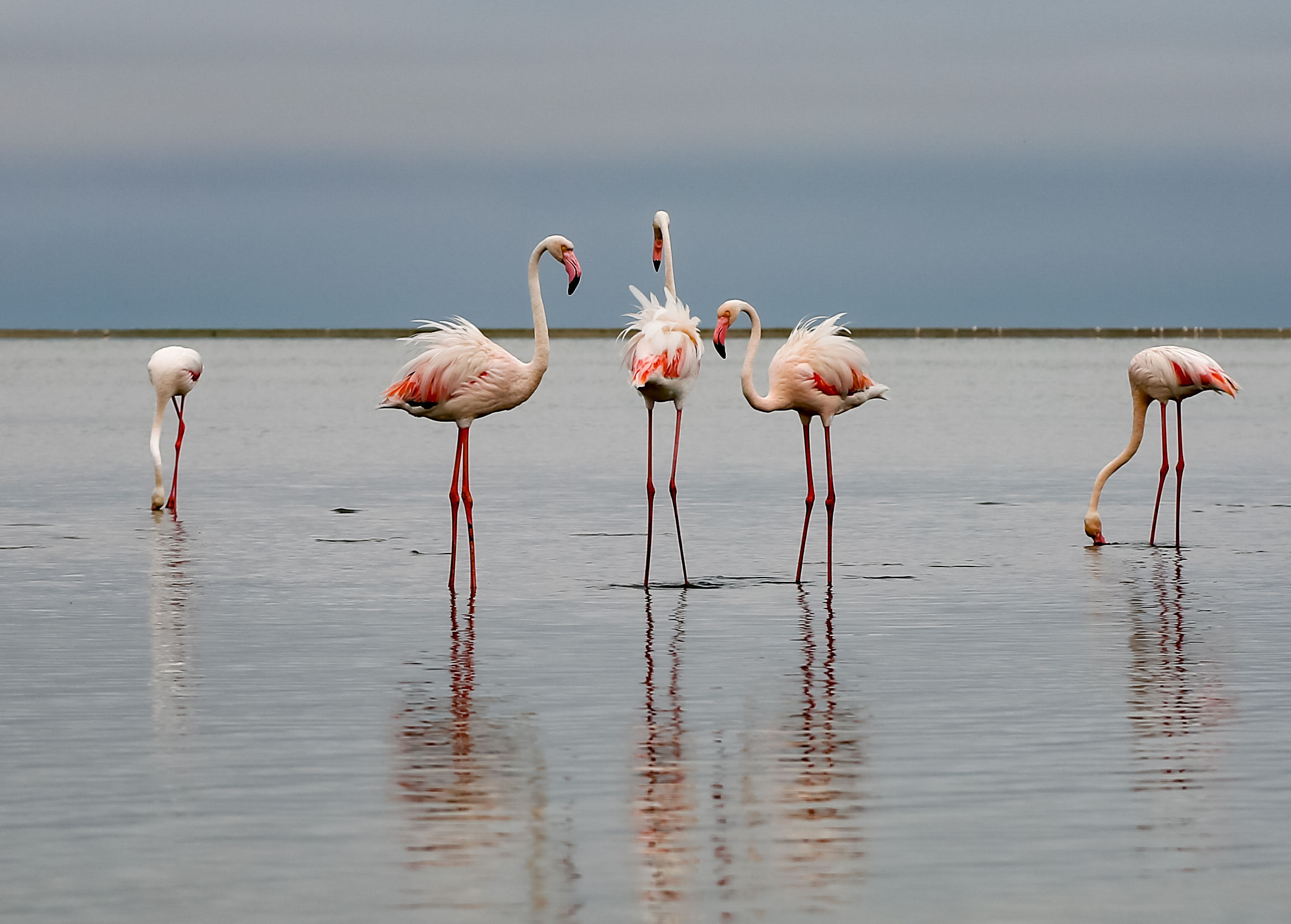 In this little drama, one bird was politely walking behind another when he suddenly decided the front one needed to move faster. He pecked at her back feathers. She told him to get lost and then the chase was on.


But eventually a truce.

And then kiss and make up. I really don't know what their behavior was, I'm anthropomorphizing them a bit, but this is how the story appeared to me.

Another time, during October, we came to Walvis Bay to see the seal colonies at Pelican Point, hoping to see baby seals. Sadly, a lot of the babies we saw were lying dead in the sand. Perhaps there wasn't enough food to support the population. Berrie didn't know what caused their death, but this didn't appear to be a particularly unusual sight to him. Jackals trot along the beach, their orange coats blending perfectly with the orange sand, as if the sand itself has gathered into shapes. Although they didn't kill the seals, I imagine the dead ones are a gift to the jackals.

We eventually stopped on the beach next to a seal colony, and I asked if I could get out to take photos. Berrie said, “Yes, you can try. But they will run away if you approach them.” I was reluctant to believe him. I know I can be pretty stealthy, though there is nothing on the beach to hide or disguise me. And I really wanted to get pictures of seals. So I crept toward the seals on my right, clicked a few shots with my camera but I was still quite far away for my zoom lens's range. I stepped gingerly forward … one step, two steps, and now they’re running into the water so fast I couldn’t even get a picture of their flight. They were already in the water surfacing like dolphins as they swam beyond the surf. OK then, I would be even more stealthy as I turned around and headed for the seals on the other side of me. But they took off before I was even as close as to the first group. So of course my friend was correct, but here are a couple photos I managed in spite of the little devils' flight.


One of the most interesting things Berrie showed me was a drive through the “informal settlements” on the outskirts of Swakopmund where many of the Black residents live -- basically shantytowns, but like an upscale shantytown. As we were driving to there along the highway, Berrie first pointed out a long stretch of condominium-type houses along the highway. Perfect squares that look decently constructed, very neat and tidy, painted with cheerful colors, though they're like an island with no other housing or shops in view. “Do you notice how no one is living in them?” Berrie asked me. I looked more closely. Maybe one in four had a car and signs of life. “The government built all those but nobody will live in them.” My first reaction was confusion why someone would prefer to live in a bodged-together tin or wooden or plastic-tarp shack with no running water instead of these prim, if small, neat houses. “Well then you have to pay rent,” Berrie explained, “and a water bill and such. But if you build your own shack in the informal settlement, no rent – you own it, you live there for free.” These settlements came into being all around the country after Apartheid ended, as suddenly there were no rules and regulations anymore about where you had to live based on your classified race. (You could not declare your own race (!) under apartheid, the government decided what you were -- there were four designations -- and registered you, and that registration dictated every single thing you could and could not do in the country, including where you could and could not live.) City codes now specify you can't build like this in the city limits, so these settlements are all just outside of the cities.
While the individual accommodations might look haphazard and ramshackle, the settlement itself is not just a random jumble of shacks. There are nice wide streets and all kinds of shops. I saw a preschool with bright murals painted on the walls, and places advertising many other community services, and shops selling everything from auto parts to chewing gum and broom handles. Some of the shacks even have two stories. And a few are being built of cement and look more like a regular house. Everyone uses the building materials they can afford.
I asked Berrie what they do for toilets and such. “I don’t know,” he realized. “Let’s ask.” He slowed our car beside two women walking on the side of the road and rolled the window down. I’m not sure why, but I was suddenly alarmed, self-conscious of my whiteness and somehow embarrassed that we were going to stop and ask these people where the toilets are in their houses. I was curious, though, if they have individual outhouses or community bathrooms like in Chinese hutongs I stayed in years ago. But the ladies weren’t offended or put off by our question. They politely explained that most people have holes at the back of their abodes they use for a loo. Berrie told me we could get out and take pictures of the settlement. I declined, again feeling a little awkward, but later I realized it’s not really any different than taking pictures in the hundreds of other villages, towns and cities I have around Namibia and all over the world. So if I have the opportunity to go back, I will take pictures. I think it's a very interesting place -- no HOAs to homogenize everything there!
Lastly, I want to share a few photos from Alzheimer's Dementia Namibia (ADN) care home. My whole reason for being in Namibia for three of my five trips there was to document in various mediums the life and work of my friend, Berrie, founder and CEO of ADN. He founded the first home in Namibia dedicated exclusively to the care of dementia patients. The original location was several hours northeast of Swakopmund in a renovated farmhouse surrounded by many acres of open land. In 2015 they moved to this current location a short drive outside Swakopmund and built a place from the ground up, tailored to the needs of both the residents and staff (who live on-site). I could go on and on about the quality of the individualized care ADN gives each of its residents, with a non-pharmaceutical approach, but I'll sum it up by simply saying that, in all seriousness, if I come to have dementia and get to the point where I don't recognize people I know anyway, I want to come here, even though it's a foreign country.
Just one of innumerable thoughtful decor details -- look at how they decorated the sliding glass doors between common areas. So fun!


And lots of open outdoor space that residents have free access to in the daytime (no closed doors to confuse or frustrate them). ADN staff recently made this spiral in the yard with rocks, thinking it might be something of entertainment or interest to the residents. Turns out it's a huge hit -- people are far more engaged with it than they even imagined, carefully walking the path outlined by the stones, outside in the fresh air.

I first visited the ADN home in 2016. It was a new experience to spend so much time around people living with dementia. It was uncomfortable but also an epiphany I'm grateful for. You can read about that in my Tuesday Tale, Bridging Dementia -- Lessons in Dignity. I've since visited two more times and have learned gobs and gobs about dementia from Berrie. And Berrie and the ADN staff continue to learn gobs and gobs through practical experience every single day through every single patient.
And one last peaceful look at the ocean on the tip of the Skeleton Coast ..... You'll have to imagine the sound of seagulls for yourself.
*
Read about driving through the dry Swakop Riverbed, a place with wondrous geology
Read about the Dune Belt, a desert sight to see near Swakopmund (about halfway through the article)
Read more posts about Namibia in Archive I and Archive II

Updates
Archive
-- AFRICA --
Namibia I
Namibia II +Witchcraft
-- NORTH AFRICA --
-- MIDDLE EAST --
- SOUTH AMERICA -
-- EUROPE --
Greece +Refugee
Camp
-- ASIA --
CENTRAL AMERICA
- NORTH AMERICA -
Travel Essays
Most Recent Additions
1. Meet Shara Kay Johnson at CanvasRebel added to Interviews
2. Meet Shara Johnson, Writer & Photographer added to Interviews
3. The Road to Columbine Heaven added to Articles by SKJ
4. Life & Work with Shara Kay Johnson added to Interviews
5. The Tiny Woman added to Travel Essays
6. Things People Told Me: Conversations in African Landscapes added to Travel Essays


